That Shift Happened in an Instant
That shift happened in an instant.
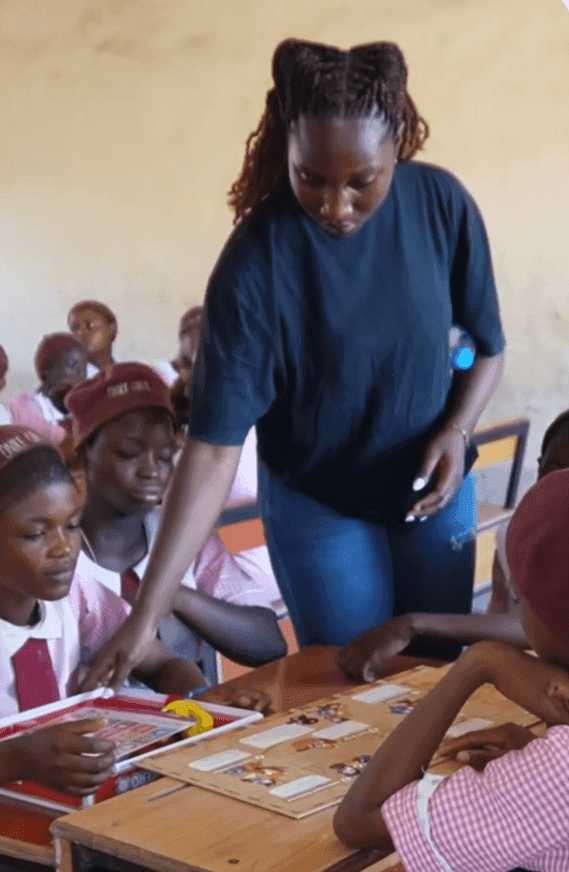
When Iyanuoluwa said, “We have a game to play,” the classroom changed. A few seconds earlier, the students had shown little interest in the phrase Sustainable Development Goals. A few seconds later, their eyes were bright. They wanted to touch the cards, build a world, and create something of their own.
That was when she realized something simple but important.
The problem was not that children did not care about the world. The problem was that adults were often using the wrong language.
“Stories and games are more powerful than lectures.”
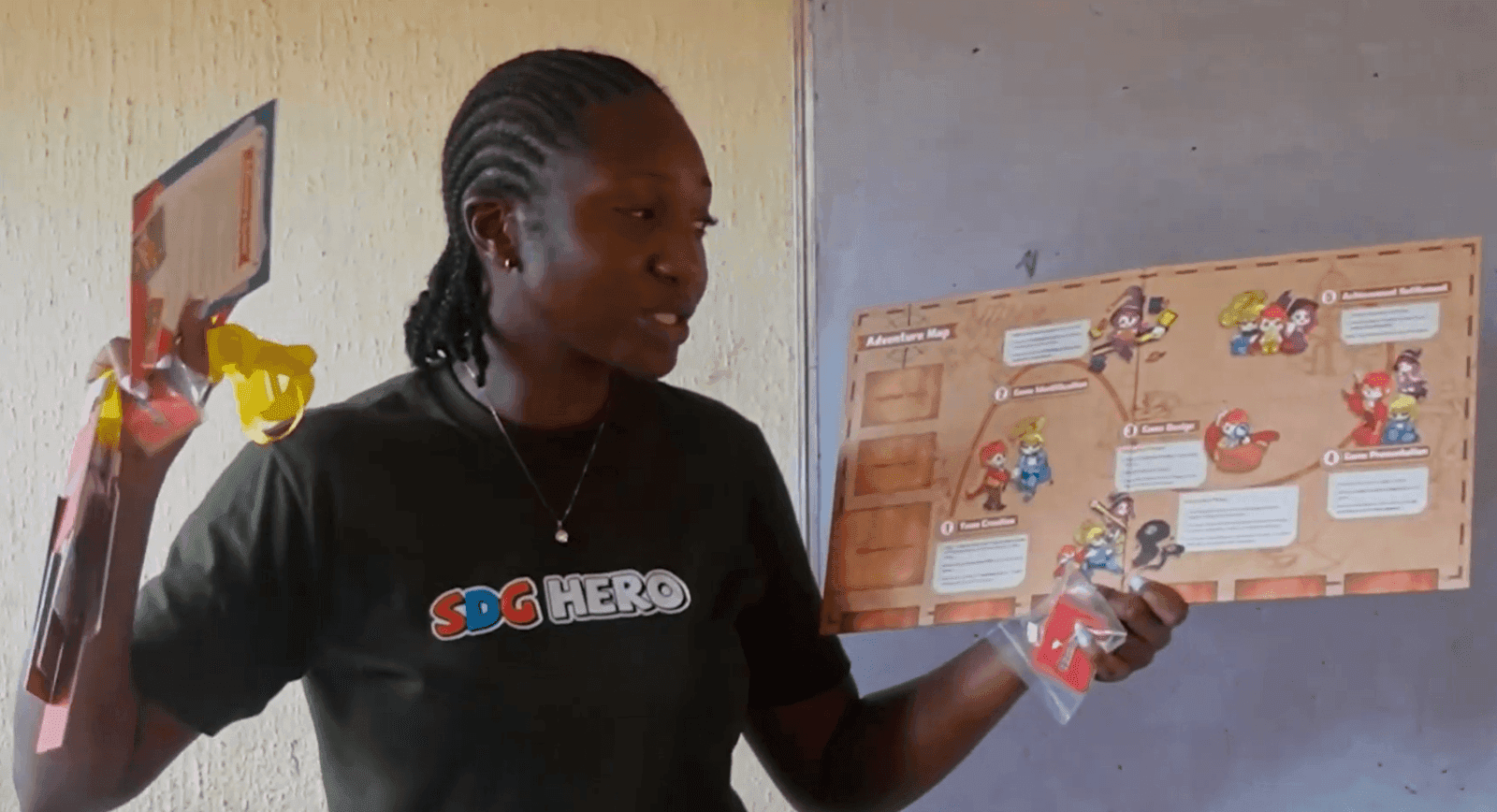
Iyanuoluwa is a volunteer and virtual assistant from Nigeria. She lives in Lagos and is originally from Ekiti State. In 2025, she became a Game Master for SDG Hero, bringing sustainability education into Nigerian secondary school classrooms through cardboard, cards, stories, and children’s imagination.
For her, SDG Hero was not just another volunteer activity. It became a way to turn abstract global goals into something young people could feel, question, and redesign.
From Volunteer to Real Participation
Iyanuoluwa cannot point to one single moment that made her become a Game Master. It was not one story, one speech, or one sudden realization.
It was a quiet inner drive: to take part in something meaningful, not only “do volunteer work.”
Before SDG Hero, her understanding of sustainable development was limited. SDGs felt like textbook ideas — important, but far away. Education, in her mind, usually meant a familiar classroom pattern: the teacher talks, the students listen, and everyone writes notes.
That method had been used for years. So it must be right, right?
Then she encountered SDG Hero and began to wonder:
What if learning does not begin with explanation? What if it begins with participation?
What the Game Changed
Iyanuoluwa’s first attempt at introducing SDG Hero did not go as planned.
She entered the classroom and began explaining what the SDGs were. She talked about climate change, poverty, and gender equality. But the students’ faces told her everything:
What does this have to do with me?
Then she changed her approach.
She said they had a game to play.
The room came alive.
For Iyanuoluwa, this was not magic. It was a shift in method. She slowly understood that many young people do not ignore sustainability because they are not smart or not interested. Often, no one has explained it in a language that connects with their lives.
Traditional teaching might say:
Gender equality is important. Climate change threatens the world. We have a responsibility to end poverty.
SDG Hero asks children to make choices:
Who should escape first when danger comes? How should opportunity be shared in a community? What happens when one decision changes the whole game?
Every choice becomes a lesson. But what children feel is not a lecture.
They feel agency, creativity, and the joy of being taken seriously.
The “Wow” Moments
One day, Iyanuoluwa challenged students to create a game with very little preparation time.
She was nervous. Would they be able to respond? Would the task feel too difficult?
Instead, the students surprised her. They moved quickly, created rules, imagined problems, and offered solutions with confidence. Their ideas came faster and bolder than she expected.
That moment changed how she saw children.
She began to believe that creativity is not a rare talent. Sometimes, it is simply hidden potential waiting for the right tools, the right space, and the right invitation.
When she introduced SDG 1: No Poverty and SDG 2: Zero Hunger, she chose stories instead of statistics. Suddenly, students began to connect.
One said, “My neighbor lives like that.”
Another said, “I have seen that in my community.”
In that moment, the SDGs were no longer distant global goals. They became something happening nearby, in streets, homes, families, and neighborhoods.
Building the Bridge Between “Me” and “the World”
Before becoming a Game Master, Iyanuoluwa rarely talked about the SDGs in daily life.
Now, she does it all the time — with friends, strangers, students, and anyone willing to listen.
Not because she suddenly became a different person, but because she understood something deeper:
Children do not need to be pushed into caring. They need to be invited into the conversation.
When she saw students shift from boredom to excitement, she began to understand education differently. Education is not only about putting information into young people’s minds.
It is about building a bridge between “me” and “the world.”
Games are especially powerful because they do not simply say, “You should do this.” They say:
Look what happens. Try another choice. Build a better rule. See what changes.
Through play, children discover answers for themselves.
A Word for Future Game Masters
If Iyanuoluwa could share one piece of advice with future Game Masters, it would be this:
“Be open and flexible. Kids may not understand big words, but they understand actions and fun. The more you connect with them through stories and relatable examples, the bigger the impact you will make.”
For her, this is the heart of facilitation.
Do not overestimate children’s vocabulary.
Do not underestimate their imagination.
Do not begin with terminology when you can begin with life.
When an SDG is connected to a student’s own experience, an abstract concept becomes a concrete choice.
Designing the Future Through Play
In Lagos classrooms, Iyanuoluwa helps students see the connection between local action and global challenges.
She is showing them that rules can be created, not only followed.
She is helping them understand that imagination is not childish fantasy.
It is a real form of power.
Maybe one day, some of these students will become community leaders. Not because an adult told them they should, but because they once experienced what it felt like to design a better future with their own hands. That is already something important.